The Argument for the Human Head: Petrides’ Heads in Context
Petrides Studio, with AI assistance
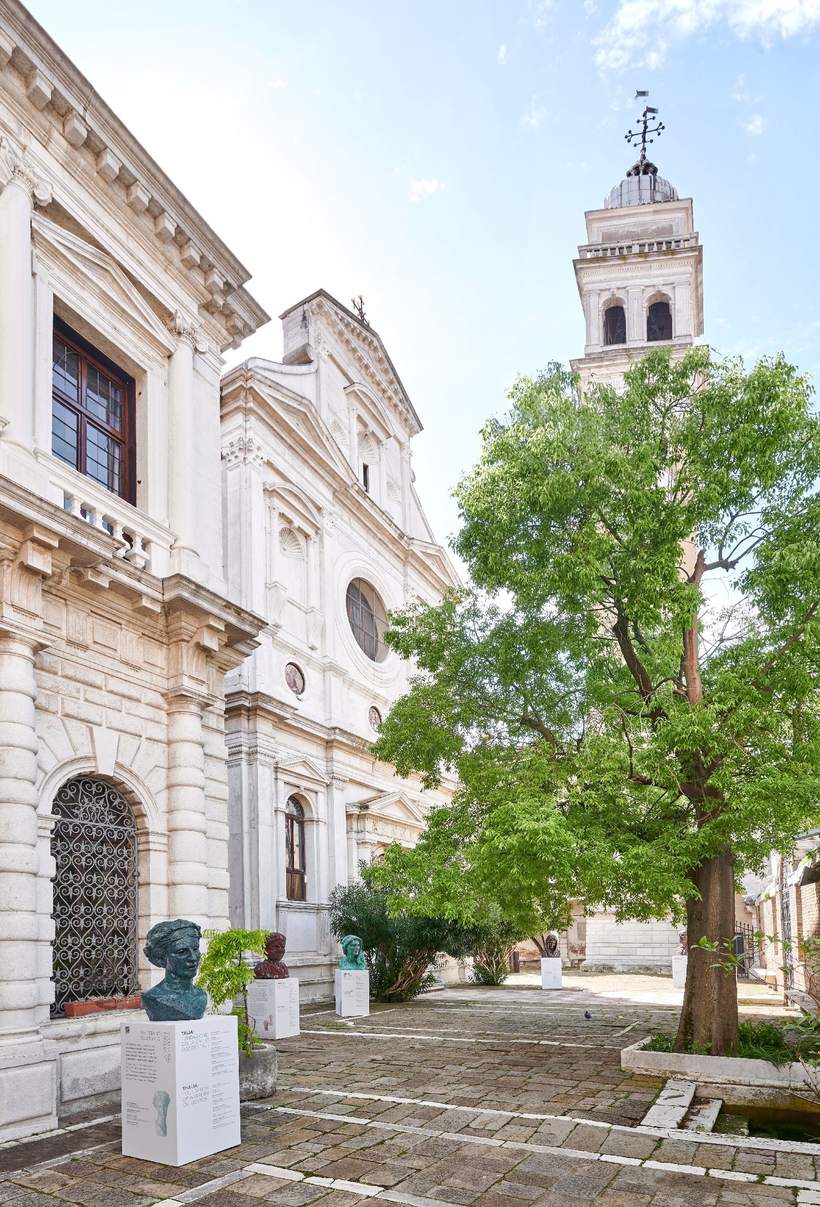
For as long as there has been sculpture, the head has carried the heaviest meanings: power, faith, grief, intelligence. George Petrides’ Hellenic Heads take up the format traditionally reserved for rulers, gods and heroes, and give it to a single Greek family marked by war, displacement and recovery. The six busts stand within that long tradition and argue with it.
In the gallery the Heads act before they explain. Each is roughly 90 cm high and set on a pedestal, so the whole reaches about two metres and stands above most visitors. From across a room they read as clear silhouettes. Up close, the worked surfaces, ridges, cuts and softened planes, make their histories tangible. Raking light indoors finds every mark of the hand; outdoors, the surfaces register weather and the changing day.
Egypt: authority without doubt
The painted bust of Nefertiti in Berlin’s Neues Museum is the best-known ancient head. Its poise and symmetry project a royal authority that admits no doubt. Petrides borrows the fact of presence: his Heads, like hers, are felt physically before they are interpreted. There the likeness ends. Where the Egyptian workshop smoothed away imperfection to show permanence, Petrides leaves tool marks, asymmetries and abrasions in view. His subjects are not eternal. They are people who lived through the twentieth century and came out of it composed, but changed.
The Parthenon: the head as civic myth
Among the Parthenon sculptures, the head of one of Selene’s horses, now in the British Museum, shows how a single head can carry a shared story: the exhausted animal sinking below the horizon as dawn breaks. Petrides reverses that logic. The horse captures one mythic instant; his Heads hold decades. They form a procession of generations, from a grandmother who fled Smyrna in 1922, through parents shaped by occupation and civil war in the 1940s, to the artist himself and the daughter who may inherit a lighter story. The Parthenon shows national myth enacted in public. Hellenic Heads shows how it is carried privately: in a grandmother’s silence, a parent’s wartime caution, and a family’s faith in work and education.
Michelangelo: the moment before
Michelangelo’s David (1501–1504) is usually read as the instant before the fight with Goliath, the furrowed brow and fixed gaze concentrated on a decision still to come. Petrides’ Heads also put the inner life before anatomical perfection, but they refuse the idealised surface. David holds a future. Petrides’ figures stand after the events: after war, displacement and hunger. Their scale and upright bearing speak of endurance, of lives rebuilt and work continued.
Rodin: the anti-monument
Rodin’s Burghers of Calais abandoned the confident civic hero for men in visible anguish, and his studies of their heads, such as Pierre de Wissant, carry the whole crisis in a face. Petrides has called the Burghers an “anti-monument to the civilian who was suffering” and cites it as a direct precedent; his Man of Two Wars looks to Pierre de Wissant. Each of his figures is a kind of burgher, bearing the weight of decisions made elsewhere and living them as ration lines, departures and silence. Rodin’s drama is public and historical. Petrides’ is familial, and its courage is the courage of carrying on.
Brancusi and Giacometti: essence and fragility
In the twentieth century Brancusi reduced the head to a polished, almost featureless form in Sleeping Muse, while Giacometti stretched it into the narrow blade of Grande tête mince (1954). Petrides sits between them. Like Brancusi he simplifies, letting large planes read as one form. Like Giacometti he accepts imbalance, so that some Heads seem tested by time. But he insists on specificity. Where they offer an essence of Man or Woman, he ties the monumental head to a family tree and a map.
Bourgeois: the psyche on view
Louise Bourgeois’s fabric heads, often sewn from her own clothes and enclosed in vitrines she called cells, turn memory and fear into private, guarded objects. Petrides shares her autobiographical source and her attention to the maternal line. Where Bourgeois keeps the psyche enclosed, he opens the cell and places it in public space, in a square, a hospital entrance or an embassy hall, arguing that the private consequences of history deserve to be seen.
Schütte: monumentality questioned
Thomas Schütte’s Wichte (Imps, 2006), a row of deformed heads set high on shelves, uses the monumental bust to mock authority. Petrides shares Schütte’s interest in what happens when the head is enlarged beyond life, but not his irony. Schütte’s heads are hollow figures of power. Petrides’ are grandparents and parents whose authority was fragile and whose endurance made a different future possible. Schütte undermines monumentality; Petrides keeps it and turns it toward resilience rather than conquest.
Coda
The Egyptian heads, the Parthenon and David used the figure to project ideals: divine order, civic harmony, heroic will. Rodin, Brancusi, Giacometti, Bourgeois and Schütte questioned those ideals or turned them inward. Petrides adds a further turn. He accepts the risk of the monument but changes its subject, honoring not the victor but those who lived with the consequences: who queued for bread, packed one suitcase, and rebuilt. In this he gives form to what Marianne Hirsch has called postmemory, the way trauma passes from one generation to the next, and to the effort not to pass it on intact. His Heads insist that personal history is history, and that a wounded face can still stand as an argument for resilience.